
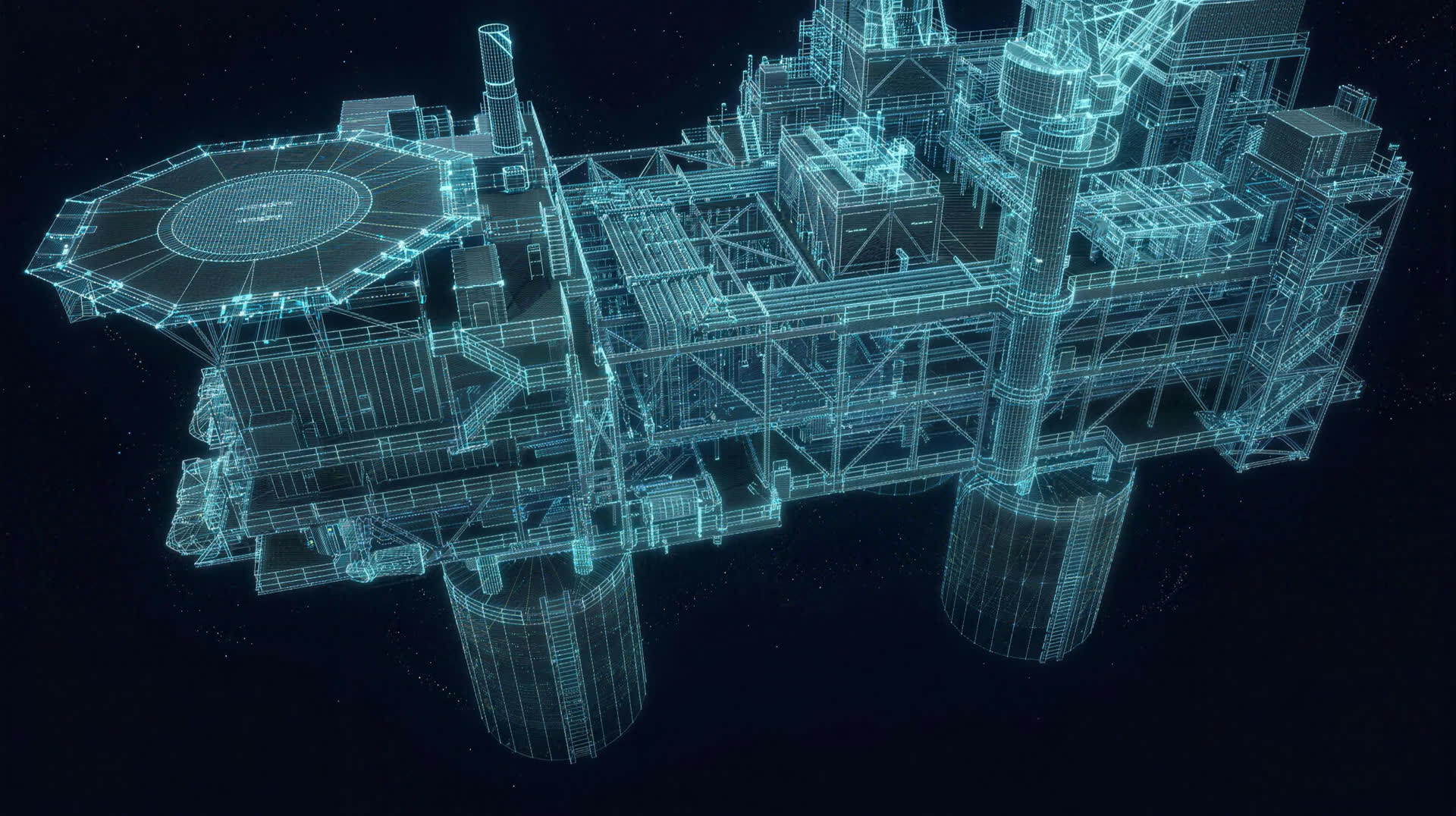
Graded. Owned. Closed.
LICHA
An inspection report describes a problem. LICHA makes it someone's problem, with a grade, an owner and a date, and shows leadership the risk they are carrying.

Why it is different
A register tells you what was found. LICHA tells you who acts.
Built around the threat
Dead legs, CUI, splash zones, temporary repairs and deck penetrations each get their own view, their own questions and their own measures.
Elsewhere: one anomaly scheme grades a refuge boundary seal on the same scale as a coating defect.
Ownership on every record
Every item carries a named owner and a due date. A red item shows who holds the decision.
Elsewhere: the accountability is real and the visibility of it is not.
The glue, not a replacement
LICHA sits alongside the maintenance system, the anomaly system and the twin you already run, and joins what they each hold about one item.
Elsewhere: another system of record to migrate into and maintain.
Actionable insight
A finding is actionable when it has a grade, an owner and a date. Anything less is a report.
Deck seals
A penetration through a rated barrier is a hole in it.
Decks and walls carry penetrations of many kinds: through fire and blast divisions, the temporary refuge boundary, smoke and gas tight boundaries, watertight decks and unrated plating. Where a penetration passes through a rated barrier, its seal carries that barrier's rating. It is sealed once and rarely opened again, so the pipe behind it is never seen, its condition is assumed and its rating is taken on trust. LICHA manages deck seals as a surface of their own: every seal identified, recorded, inspected, owned and reported against the barrier it protects.
One seal for every penetration. The rating carried by a certified seal.
The MAKO seal fits any deck penetration. Where the barrier is fire rated, it works with a certified fire rated seal and still gives what fire rated seals on their own do not: access to inspect, an identity, a history and safe removal.
- Fits every deck penetration Today
- Works alongside certified fire rated seals, which carry the rating Today
- Inspection access built in: the plug lifts out and reseats Today
- Inbuilt tag: every seal identified and catalogued Today
- Its history recorded in LICHA Today
- Removed safely and refitted without hot work Today
- Protects against mechanical damage, impact and in-service degradation Today
- Scan the tag on deck to open the record By project
The MAKO seal is not itself fire certified. On a rated barrier it is used with a certified fire rated seal, which carries the rating.
The deck seal strategy
Six stages. One seal record through all of them.
Identify, catalogue, inspect, maintain, repair, manage. Each stage adds to the same record, so the seal on deck and the seal on the leadership report are the same seal. Step through it.
Under the performance standard
A seal is part of a safety critical element.
Fire and blast divisions, the temporary refuge boundary and watertight decks are barriers with performance standards. A penetration through one inherits that standard. LICHA ties every seal to its barrier rating and performance standard, and every standard to a named owner.
One failed seal breaks the rating of the whole division. LICHA puts the seal on the out-of-compliance list with its owner named and its inspection notes on the record. A roll-up view by division is delivered by project.
Advanced NDT
Inspect behind the seal without taking it out.
The corrosion that matters sits where nobody can see it: the pipe wall inside the penetration. The inspection plug gives access. Guided wave screening covers the length of pipe through the seal from one access point, and any indication goes to a targeted follow-up technique. Every result is graded and lands on the seal's record.
- Screen the whole length. Guided wave reaches through the seal from one access point.
- Follow up where it matters. Indications go to a targeted technique, not a blanket campaign.
- Grade it once. Result, grade and date go on the seal record and roll up by barrier rating.
Digital twin
Every seal, located.
Each seal record carries a link to its place in the twin you already run, so the team on deck and the engineer onshore look at the same penetration.

Illustrative twin render. Select a seal. Today each record carries a link to its location in the twin. Seals shown on the twin itself are delivered by project with the operator's twin platform.
Five threats
Each threat fails its own way.
One engine grades, owns and closes every finding. Each threat gets its own question, its own measures and its own view. Choose a threat and try it.
The question LICHA answers
How LICHA works
Six steps. One record through all of them.
The same item moves from first identification to leadership reporting without being re-keyed. Each step has an owner.
Organisation and accountability
Every record has an owner.
Every record, standard and sign-off has an owner. When someone moves, the records move with them.
Leadership visibility
Evidence behind the barrier model.
A barrier model states which barriers stand between the hazard and the event. LICHA shows whether each one is holding today: every item tied to its performance standard, every standard to an owner, and compliance against target on one screen.
Senior leaders see their risk without asking for a report. Red and overdue items come with the name of the role that holds them.
Management of change
See whether change is being managed.
Removing insulation for good, extending a temporary repair to life of field or deferring an inspection are changes to the asset. LICHA holds the MOC against the item: who must sign, who has signed, and which documents still need red-lining.
An MOC stays in draft until every assigned authority has signed. A repair past its design life with no deferral shows as out of compliance.
Sign-off status is recorded against the item. Authenticated signatures are planned.
Permanent removal of insulation.
Sign-off
Red-line markups
MOC-0038
RP-0019, repair to life of field
Signed off
DEF-0007
RP-0004, deferral of replacement
Draft
No MOC
RP-0011, past design life
Out of compliance
CUI strategy
Every insulated line against its ten-year plan.
Each line carries its cladding, the technique assigned to it, its place in the cycle, and how much has been stripped against how much the plan says should have been. Compliance with the strategy is visible line by line.
Bright band is the share added in that cycle. Dashed rule is stripped to date. Illustrative figures. The cycle and its increments are set with the operator.
Technique by cladding
Technique follows the cladding. Non-metallic cladding can be screened through. Metallic cladding needs a technique that works through the jacket, or a strip.
| Line | Cladding | Technique | Stripped against plan | MOC |
|---|
Planned
Digital twin
Every tag, in its place.
A register row is a tag and a number. On the twin it has a location, neighbours and context. Each LICHA record links to its position in the operator's twin, so the reviewer, the authority and the repair team see the same picture.

Illustrative twin render. Select a tag. Today each record carries a link to its location in the twin. Tags shown on the twin itself are delivered by project with the operator's twin platform.
Integration
Not a replacement. The glue.
The work order lives in the maintenance system. The anomaly lives in the anomaly system. The location lives in the twin. LICHA joins them on the item, so the decision is made with all of it in view.
Today LICHA holds the references and loads data by CSV. Direct connections to each system are scoped by project.
The dashboard
Five threats. One engine.
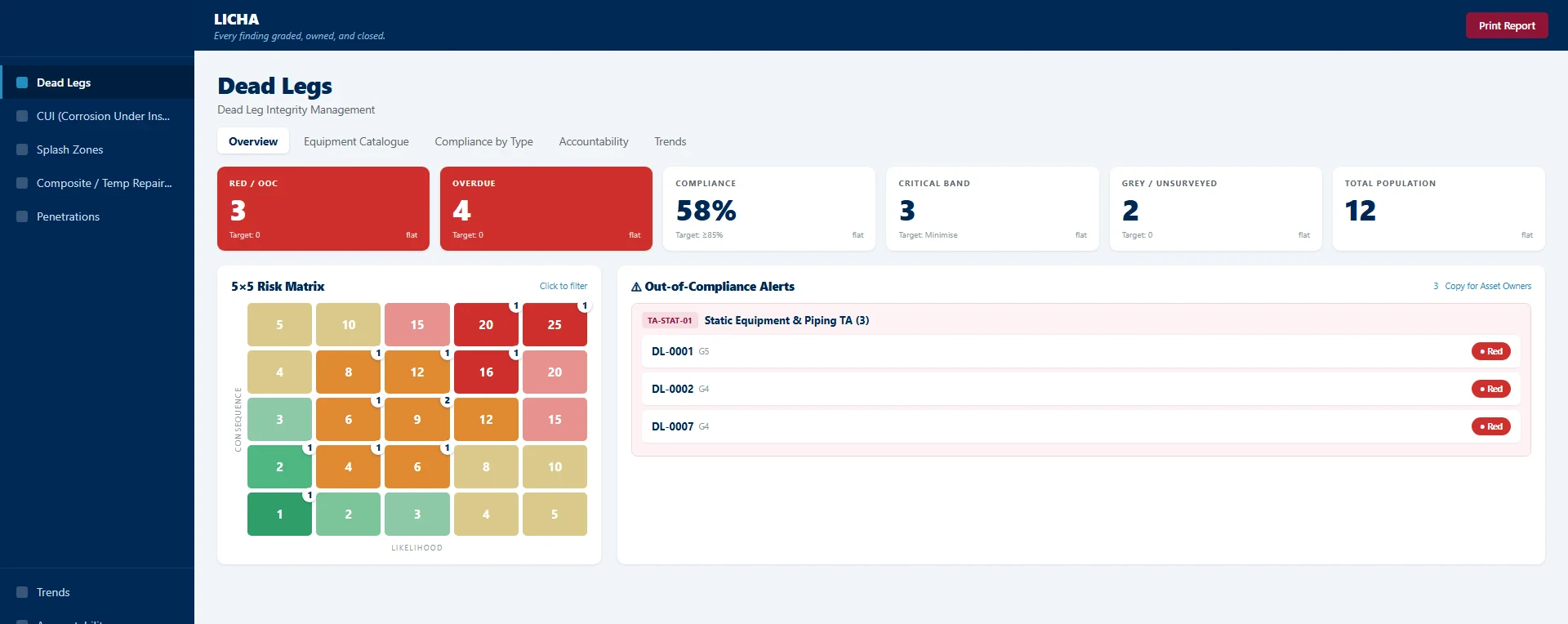
Screens from LICHA. Alias identifiers, illustrative figures.
One asset. One threat. Run it live.
Choose deck penetrations or CUI on one asset. Your technical authorities set the criteria. Your data, your decisions, visible from the first campaign.
Request a demonstration